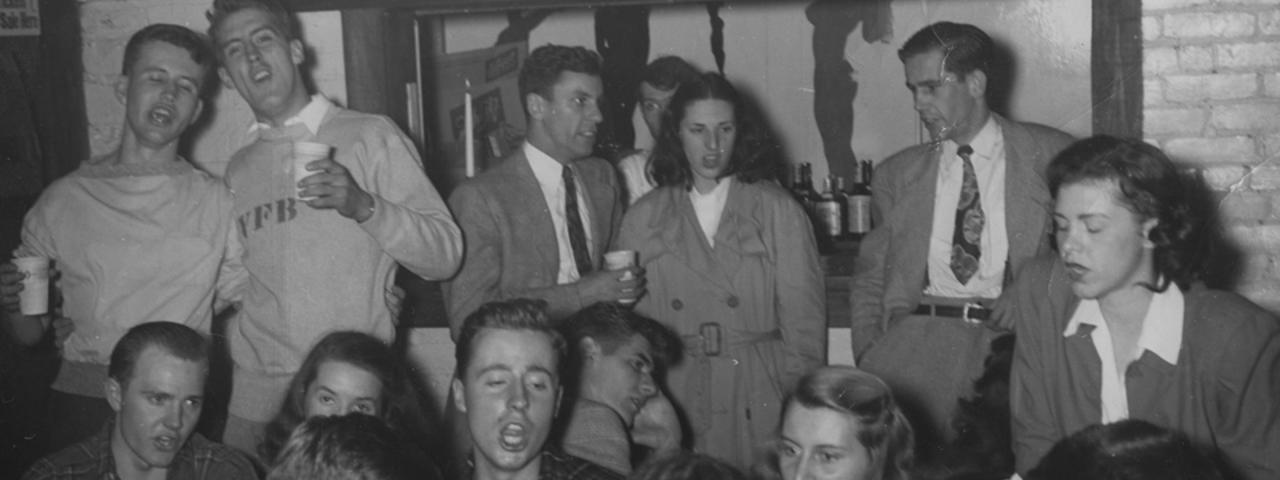
Omicron Zeta is one of the oldest chapters of Lambda Chi Alpha, having held its charter continuously since installed on October 11, 1913. The many generations of Cornellian Lambda Chi’s are linked through our common history, our shared traditions, and our timeless ideals.
Ithaca in the nineteen hundreds was quite different from the present seat of Cornell. There were few automobiles, no motion pictures, and co-eds were severely frowned upon. Perhaps as a result of these factors, college spirit was very strong; class rushes and banquets, football games, and every event of interest to the University in general, received most enthusiastic, and often boisterous support.
As might be expected, manifestations of joy knew no bounds on the evening of the Princeton game in 1907, incidentally the last for may years. Cornell had won the game by a considerable score. [1] The student body and alumni staged a combined parade through the town. Tiring of this they drifted into various tap rooms for refreshment….
One group composed of mostly seniors began talking… Two of them had been in the habit of rooming together. They recalled a fruitless attempt to evade the sophomores before their freshman banquet. [2] Several had taken part in a German play. [3] Several had occasionally met during the four years for a sociable stein of beer. Before the evening was over the group agreed to meet weekly; an informal organization and ritual grew up. Outsiders were quick to dub the new club such names as “Mug and Jug” or “Keg and Leg”… hardly suitable, so the name ISWZA was adopted, composed of the initial letters of the son decorating the master stein which held the evening supply of beer…. [4]
By spring a substantial organization existed and a badge had been designed. The pledge pin was a pentagon bearing the turtle design which adorned the lid of the master stein. The seven original members, Otto Brandt. Jr, L.M. Brockway, C.J. Hunn, F.K. Pearce, N.D. Preston, A.U. Wetherbee, and E.J.C. Fischer… found the associations of this club so enjoyable that they sought to perpetuate it. Accordingly the following men were admitted to membership: G.P. Brockway, F.J. Grant, B. Kelley, E.W. Nicholoy, and W.M. Sutton.
In the fall of 1908 the remaining members roomed near together to facilitate the activities of the society…. Rapid growth continued. In 1913 a house on Stewart Avenue was purchased…. [T]he ISWZA society had become a permanent and strong local fraternity. The advantages of membership in a national organization became apparent at this stage. Lambda Chi Alpha at the same time was seeking to establish a chapter at Cornell. Joseph A. Carr, later killed in action in the World War, was in communication with Albert Cross of Epsilon Zeta, Pennsylvania; soon negotiations were under way…
In the days when unorganized class rushes were traditional at Cornell University, the class of 1907 when sophomores attempted to prevent the freshmen from attending their banquet. This class was the last to have its frosh banquet and preceding rush because of previous disastrous results.
Several members of the class of 1908, anticipating the rush, purchased sufficient edibles and secreted themselves under the rafters of a famous old freshman rooming house several days earlier to avoid capture and imprisonment. The 1907 men, however, procured ladders, cut holes in the roof, and reached the first year men. [q.v. The Famous Freshman Melee]
The freshmen became close friends. In the fall of their senior year, six of them banded together for weekly meetings, brining in one sophomore, a member of the class of 1910. Organization took place on the even of what was to be the last Cornell-Princeton football game for many years, that of October, 1907. Meetings were held weekly at a pre-Volsteadian rendezvous in Ithaca on Saturday evenings. Outsiders, however, coined new names for the Mug and Jug, so the meeting place was changed. The year of 1908 saw meetings held in the rooms of members in turn. As the semester neared a close, the one sophomore, having been invited to membership in a national fraternity, raised the question of permanency. It was then decided to recruit more members from the lower classes and draft plans for a permanent club.
The name of the new organization was taken from the first letters of the first line in the first stanza of a German “bier knieppe” song, found on the large tankard used in the days of Mug and Jug. The song starts “Im Schwarzen Wahlfisch Zu Ascalon,” so Iswza was the adopted name. The original seven men were assigned letters, and the initiates were numbered. The pin was square, tilted through forty-five degrees, the letters SWZA appearing in the corners. There were three pearls on each side, and in the center square on blue enamel was a gold turtle; on its back was the letter I, and in the center of the I was a small opal.
The seven original members were Otto Brandt, Jr., Newark, N.J.; L.M. Brockway, Walcott, N.Y.; C. J. Hunn, Ithaca, N.Y.; F.K. Pearce, Brooklyn; N.D. Preston, Brooklyn; A.U. Wetherbee, Union Springs, N.Y.; and E.J.C. Fischer, Hazleton, Pa. The additional members admitted on the organization of Iswza were G. P. Brockway, F. J. Grant, B. Kelley, R.B.T. Kiliani, E.W. Nicholoy, and W. M. Sutton. The members were scattered about town so there was little opportunity for rushing. In the fall of 1908 the men started to concentrate by rooming closer together. Fischer, Grant, Kiliani, and Sutton rooomed at 305 Dryden Street. In the fall of 1909 a house was rented on Linden Street and more men were initiated. [q.v. From Mug and Jug to ISWZA]
The first house was occupied for two years,and then the group moved to Bryant Avenue for two years. In the fall of 1913 decision was made to purchase a house at 614 Stewart Avenue for $18,000. This house was occupied until 1920, when it was sold to Sigma Alpha Mu.
Soon after the purchase, the undergraduates felt a desire to petition a national fraternity, and conferred with the alumni. Joseph A. Carr, who was killed in action in the World War, was in contact with Albert Cross, Pennslvania, Negotiations were completed, and on October 11, 1913, Iswza became Omicron, the twelfth chapter of the Fraternity. All members of Iswza save Nicholoy, Grant, Kelley, and Blythe have since become members of Lambda Chi Alpha.
The loyalty of the Omicron alumni can be determined from the unusually large attendance at Ithaca on or about February 7 of each year, the founding day of Iswza. Annual dues of $6 made possible the early payments on the houses the chapter has owned.
The chapter progressed until the war, when the house was vacated owing to S.A.T.C. rulings. One by one the men departed until only Cuthbert Fraser remained in the fall of 1918. However, by the opening of the second term members came drifting back, and the work of reorganizing the chapter was started. The big problems confronting the chapter were the pledging of men to fill the places of those who did not return and paying off the financial obligations that had accrued during the war period.
The alumni gave invaluable assistance. Before the war, when the alumni were comparatively few, a rather loose organization existed. Class secretaries were chosen, but their chief duties were the collection of dues which had been for indefinite purposes. The men kept in touch with each other by means of "round robin" letters, but as the number increased the need for a chapter periodical grew. The Omicron Alumni News was soon instituted, and has been issued three or four times yearly ever since.
The need for a stronger alumni association grew. A group of alumni gathered in New York City to draft by-laws and provide for a permanent and strong organization. The house itself, was owned by Iswza Fraternity, Inc., a holding corporation, which had given notes to cover the cost of its purchase.
The chapter speedily outgrew its old house, and in the spring of 1920 at the 1910 class reunion at the first intercollegiate regatta held in Ithaca, the alumni voted to sell the old property and to purchase the present one at 125 Edgemoor Lane. This new property, overlooking the Cascadilla Gorge and having a replacement value of $100,000, was more suitable to the growing needs of the chapter and placed Omicron in a position that compared favorably with that of other chapters on the campus. The scheme of financing has been such that the indebtedness is expected to be discharged by 1933.
In the first several years after purchase, efforts by the undergraduates were concerned chiefly with improving their property. Participation of members in university affairs dropped. University rush systems became disorganized. Omicron experienced several lean years. Since then, however, much progress has been made.
In 1924 the original members of Mug and Jug established the Pearce Memorial Library. Endowment and piano funds were started in 1923. That fall the latter fund was sufficiently large to allow the purchase of a new baby grand piano. Lastly, a strip of land bordering the chapter’s property was bought from Chi Phi, whose house adjoins. The university wanted to construct a public walk on the strip, but members of Omicron desired to retain the chapter’s privacy. Numerous improvements have been made this fall. Work of filling in and grading the grounds has been started. Furniture has been re-upholstered. The sophomores and the steward department have joined to provide a new set of silverware. Representation in diversified university affairs has mounted to an imposing height.
In conclusion it can well be said that Omicron enjoys a high position, at Cornell and in Lambda Chi Alpha. It ranks high scholastically; its property is owned and financial arrangements generally sound.
When Lambda Chi Alpha chartered its thirteenth chapter at Cornell in 1913, it accepted a strong local society: I.S.W.Z.A. Established in 1908, it incorporated in 1913 as ISWZA Fraternity, Inc., the name of the alumni corporation to this day.
ISWZA grew out of an informal club called Mug and Jug formed in October of 1907. When its members decided to formalize their organization into a permanent fraternity, they chose the name I.S.W.Z.A. from the letters engraved on the master stein that held their evening’s beer (i.e. the jug from which their mugs were filled). These, in turn, were the first letters of the title of one of their favorite kniepe songs: “Im schwarzen Walfisch zu Askalon.”
There is no single accepted pronunciation of “ISWZA,” as it is an invented word. Brothers from older generations usually stress the first syllable: “ISS wah zah.” Since at least the 1980s, “iss WHUH zah” has been a common alternative.
The lyrics below are attributed to Josef Viktor von Scheffel in 1854, and set to the traditional German tune “Es war einmal ein Zimmergesell.” The German fraternity Verbindung Leonensia’s recording of the song is available for download as an MP3 (1.6MB) from their website.
* Dattelsaft, literally, “date juice.”
** aus Nubierland, literally, “out of Nubia.”
NOTE: While approved for public distribution, this version may contain some strong language. Registered alumni may contact the High Kappa for brother-only editions.
The Alma Mater was written by Archibald C. Weeks '1872 and his roommate Wilmot M. Smith '1874, who set the verses to the ballad "Lovely Annie Lisle." Cornell insists it is the first school to use the tune, which is played at the noon concert on the chimes.
Far above Cayuga's waters with its waves of blue
Stands our noble alma mater, glorious to view.
Refrain
Lift the chorus, speed it onwards, loud her praises tell.
Hail to thee, our alma mater: Hail, all hail Cornell!Far above the busy humming of the bustling town,
Reared against the arch of heaven looks she proudly down.
The Evening Song was first published in 1877 in the Cornell Era, and it is played on the chimes daily to close the day. This arrangement is by Henry Tyrell '1880; it has been sung to "O Tannenbaum" since at least the 1909 edition of "Songs of Cornell."
When the sun fades far away
In the crimson of the West,
And the voices of the day
Murmur low and sink to rest.
Refrain
Music with the twilight falls,
O'er the dreaming lake and dell,
'Tis an echo from the walls
Of our own, our fair Cornell.
Welcome night, and welcome rest,
Fading music, fare thee well.
Joy to all we love the best,
Love to thee our fair Cornell.
This song for alumni is actually only the refrain of the original song penned by Will Dillon '1917.
Oh, I want to go back to the old days,
Those good old days on the hill.
Back to my Cornell, For that's where they all yell,
Cornell, I yell, Cornell. (Cornell!)
Far above Cayuga's waters I hear those chiming bells.
Oh, I'm longing and yearning And always returning To my old Cornell.
Many more and less politically correct versions of this song exist.
I am the Freshman all timid with fear
I was nursed by my mummy, but now I drink beer
I miss my old bottle, it's sad for to tell
For soon I'll get busted right out of Cornell
Refrain
Oh, it's one two, and three four, we all fall in line
To the tune of our profs we must always keep time
And it's work like a Turk till your eyes ache like hell
In this grand institution, this school of Cornell
I am the Sophomore with debonair look
My vile freshman manners I long have forsook
I used to date girls from Elmira and Wells,
But now in my opinion the best are Cornell's.
I am the Junior a-takin' my ease
I go to my classes whenever I please
I frequent the bars, and the barmaids as well;
I've not been a-wastin' my time at Cornell
I am the Senior tormented with doubt
You see, my time at Cornell has almost run out
The world situation has me quite annoyed:
I'm magna cum laude, but still unemployed.
Possessive of its independent musical heritage, Omicron Zeta has never regularly sung tunes from the national songbook, but they remain in the collection.
All hail, all hail to Lambda Chi,
Our fair fraternity
We'll laud her praises to the sky
Wherever we may be
In East, in West, in North, in South
Is found our faithful band;
To colors, purple, green, and gold
We pledge both heart and hand.
Oh, We're all good brothers, each one the other's friend
and we'll be good brothers until this world shall end.
So while we're together lets give a rousing cheer,
for Lambda - Chi - Alpha, the bond we hold so dear.
Put your arm around your brother, stand together man to man,
As we grow older, we're brothers in a band
That binds us together until the day we die
We're faithful forever to dear old Lambda Chi.
Let's give a hip hip hooray, for dear old Lambda Chi,
Let's give a hip hip hooray, and shout it to the sky.
We'll make all of the rafters ring when all of the brothers sing,
About the cross and crescent, because it's the grandest thing.
We'll shout it all day long, We'll shout it loud and strong,
For we want the whole world to know, (to know),
We stand together to now, we stand to win, and how!
For dear old Lambda Chi.
A song adopted by Lambda Chi Alpha chapters across the continent. Words and music by Rushton Moreve, and performed by Steppenwolf.
I like to dream,
Right between my sound machine
On a cloud of sound,
I drift in the night
Any place it goes is right.
Goes far, flies near,
To the stars away from here;
Refrain
Well, You don't know what we can find,
Oh why don't you come with me little girl,
On a Magic Carpet Ride,
You don't know what we can see,
Why don't you tell your dreams to me,
Fantasy will set you free.
Close your eyes girl,
Look inside girl,
Let the sound take you awayLast night I owned Aladdin's Lamp
And so I wished that I could stay.
Before the thing could answer
Someone came and took the lamp away
I looked around,
A lousy candle is all I found!
The official fight song of Cornell University, written by Charles Tourison '1905 and sung to "Give My Regards to Davy." It is sung by a freshman (piker) to Registrar Davy Hoy '1891 and Professor "Tee Fee" Thomas Crane about getting "busted" out of school for drinking too much. The second, unofficial verse appears in our songbook and apparently refers to an attempt under former Cornell President Deane Malott to ban room parties in fraternities in the 1950s.
Give my regards to Davy, remember me to Tee Fee Crane.
Tell all the pikers on the hill that I'll be back again.
Tell them of how I busted, lappin' up the high high ball.
We'll all have drinks at Theodore Zinck's when I get back next fall.
Give my regards to Ezra, remember me to Andy White.
Tell all the virgins on the hill that I'll be back some night.
Tell them just how I licked it, lappin' up the brew at Jim's.
We'll all take shots at Deane Malott's when I get back again).
Specially for football rival University of Pennsylvania. Many versions of the song exist both at Cornell and at other institutions.
The itsy bitsy spider went up the water spout
Down came the rain and washed the spider out
The sun came out and dried up all the rain
And the itsy bitsy spider went up the spout againHarvard's run by Vassar, Vassar's run by Yale.
Yale's run by Wellesley, Wellesley's run by tail.
Princeton's for the pretty boys and drunkards go to Penn,
But far above Cayuga's a race of hairy men.
Oh we are the race of hairy chested men, hairy chested men, hairy chested men.
Oh we are the race of hairy chested men, and we are from Cornell.
We are from Cornell, we are from Cornell (Cornell!)
Oh we are the race of hairy chested men and we are from Cornell.
Don't send my son to Harvard, the dying mother said.
Don't send my son to Yale, I'd rather see him dead.
Send him off to Darmouth, or better yet, Cornell.
And as for Pennsylvan-i-a, I'll see him first in hell!
To hell, to hell with Pennsylvania,
To hell, to hell with Pennsylvania.
To hell with U of P#8212; P-U!
(innocently) We were only, only, foolin',
We were only, only, foolin',
We were only, only, foolin'—
The hell we were! P-U! P-U!
If I had a prick of steel and balls of solid brass
I'd find a marble statue, and ram it up her ass
We'd breed a race of giants, who'd roam throughout the land
To swell the glorious chorus of “the Quakers be damned.”
Probably a modification of a traditional MIT fight song, sung to "Battle Hymn of the Republic"
Godiva was a lady who through Coventry did ride,
To show to all the villagers her lovely pure white hide.
A most observant villager— a Lambda Chi, of course—
Was the only one to notice that Godiva rode a horse.
Refrain
We are, we are, we are, we are, we are the Lambda Chi's
We can, we can, we can, we can demolish forty ryes.
Drink up, drink up, drink up, drink up and come along with us,
'Cause we don't give a damn for any old man who don't give a damn for us!
Now men will come a long, long way, and men may go so far
To take Godiva from her horse and stand her at the bar.
But the one who took her from her horse and bought the girl a rye
Was a bloodshot-eyed fraternity man, a drunken Lambda Chi!