As every A.M. learns, the function of ritual is to turn abstract principles into a concrete, physical practice, tying them together in the member’s mind. The A.M. Ceremony is the first ritualistic step an outsider makes to come into unity with our brotherhood. A condensation of the rituals of Theta Kappa Nu (which Lambda Chi Alpha absorbed in 1939), the A.M. Ceremony binds the brothers and new members with mutual obligations and spurs introspection leading up through formal Initiation. It has been an open Ritual since the 1970s.
The candidate must ask to join of his own free will, pledging himself to the following:
Upon the written acceptance of these obligations, the High Alpha outlines the objectives of the Fraternity and asks for the candidates’ oath to Lambda Chi Alpha:
Of my own free will, I, [full name], do promise and swear, before God and before the brothers of Lambda Chi Alpha, that I will for the rest of my life abide by these solemn pledges:
I will never divulge any of the secrets of Lambda Chi Alpha which I shall learn now or hereafter to any person who is not a member of the Fraternity. I accept the obligations with which I was charged before I entered the chapter room without reservation or evasion. I will strive with the help of God to be true to the ideals and objectives of Lambda Chi Alpha.
To which I pledge my oath and faith, in accordance with the Christian teachings of this Ritual, and as a gentleman. For the least violation, I invoke upon myself expulsion, suspension, or other lawful penalty.
So help me God!
While Lambda Chi Alpha was founded as a Christian society and are Rituals show a significant debt to Christianity (notably, of the High Church), we believe these ideals transcend religious difference, and are not peculiar to the Christian faith.
The lessons of the Associate Ceremony are conducted by five officers in turn: the High Delta, High Beta, High Phi, and High Kappa, all led by the High Alpha.
Fraternity
The High Delta defines our fraternal goal as “Establishment of a brotherhood for the cultivation of good will among men.” We can rise to sucess with the support and encouragement of our brothers. We are obligated in turn to assist others, particularly our brothers.
Patriotism
“Fostering of the highest ideals of patriotism” is the lesson of the High Beta. We are able to aspire to our true dignity but for freedom, justice, and democracy. We are bound not in blind allegiance, but to support these ideals, being tolerant of others and supportive of their rights and personal endeavors.
Education
The High Phi urges the members to the “Acquirement of sound learning.” We are made fit for service through the educational resources that society has put at our disposal. It is our moral duty to make the best use of them, and to return our service to society.
Morality
“Observance of the laws of God” is the most important ideal, the lesson of the High Kappa. Before anything else, we must make ourselves active and upstanding citizens. We are reminded that God has given us the way to become true men by providing us with principles for right living.
At the conclusion of the lessons, the candidate is invested with the Associate Member Pin. The High Alpha explains its meaning:
As a token of your acceptance of our pledge and of our desire to be of assistance to you, whom we hope to know as brothers, you have been invested with the badge which is the emblem of Associate Membership in Lambda Chi Alpha. It consists of four equilateral triangles, standing for fraternity, patriotism, learning and morality, and upon them has been imposed a monogram of the letters Lambda, Chi, and Alpha, the significance of which will be explained to you at a later time.
And the ceremony ends as each brother in turn shakes hands with each of the new Associate Members.
The emblems and insignia of Lambda Chi Alpha serve not only as symbols of our fraternal identity, but as a sort of Ritual incarnate, everyday reminders of our ideals.
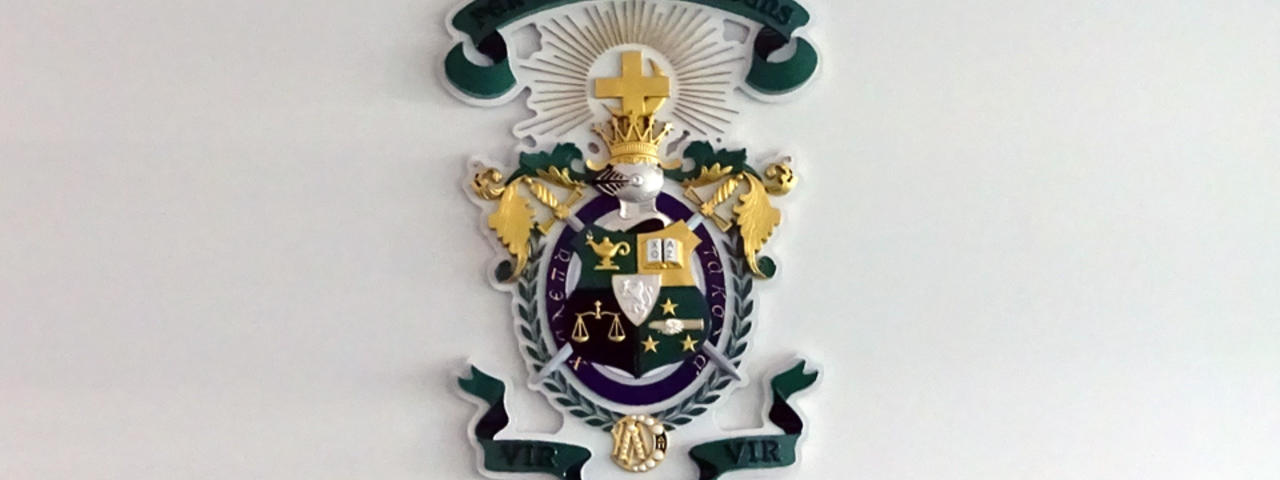
Perhaps the most commonly seen artistry representing Lambda Chi Alpha is our coat of arms, developed (unlike that of most fraternities) after careful study of the rules of heraldry. Designed by Jack Mason of Epsilon Zeta (University of Pennsylvania), our coat of arms displays our three open mottos, translated from top to bottom, “Crescent in the Cross,” “Naught Without Labor,” and “Every Man a Man.” Present are the crucicrescent, the lamp of learning, the clasped hands of brotherhood, and other symbols, as well as the inescutcheon signifying our merger with Theta Kappa Nu (the white rose is our fraternity flower) and the badge of membership below. In the medieval rules of heraldry it would be described as such:
Escutcheon: quarterly 1, vert, a lighten Greek lamp or; 2, or, an open book proper, bearing on its face the letters Chi, Omicron, Alpha Zeta; 3, able, a balance, or; 4, vert, a pair of clasped hands argent, between three mullets in chevron or; over all an inescutcheon argent, lion rampant holding a white rose slipped proper.
Behind the escutcheon a pair of swords in saltire, points downward, argent, pommels, and hilts or. Mantling vert, lined, or.
Encircling the escutcheon a riband purpire, edged argent, bearing the Greek motto Chalepa ta Kala surronded by an olive wreath which bears pendant the badge of the brotherhood.
Below the escutcheon a scroll with the Latin motto Vir Quisque Vir.
Crest: issuant from a crown celestial or, ensigning a gentlemen's helmet proper, a crucicrescent rayonne or, Latin motto Per Crucam Crescens, on scroll.
[from Baird's Manual of American College Fraternities, 19th Edition, (1977), p300.]
The Badge of Membership of Lambda Chi Alpha is among the most meaningful in the fraternal world. Each stone, letter, and line, and each circle of the crescent has a special meaning. Lambda Chi Alpha shares with Theta Chi, Triangle, and Alpha Chi Rho the distinction of using both a monogram of its letters and a key fraternal symbol in the shape of the badge.
Our membership badge is made with the lambda being struck separately from a single piece comprising the chi, alpha, and crescent. The background for the letters delta and pi is enameled, and the lambda is joined to the remainder of the badge (always yellow, white, or green gold) before the eight crescent pearls and (optional) stones in the lambda are set.
The centrality of the badge is a custom continued from our fraternal predecessor literary societies. The Badge is properly worn over the heart, preferably with a badge guard bearing a monogram of the member’s zeta designation, and only by initiated members, their wives, and their fiancees (special exceptions may be made for some housemothers).
Cornell’s chapter of Lambda Chi Alpha holds a footnote in our fraternal history. By the time Omicron was chartered in 1913, the General Fraternity had approved a badge, designed by William Thegen’s Sons, Jewelers. They were jeweled as per the wishes of the Pennsylvania Chapter with eight pearls in the crescent and eleven in the lambda. Most early badges were produced by Hoover and Smith of Philadelphia.
Perhaps disliking the connection to Pennsylvania— Cornell’s archrival— (although this is speculative), Lambda Chi’s at Cornell took a break from the national precedent, an unusual step for such a young chapter. Beginning with our installation in October of 1913, badges were instead secured from the L.G. Balfour, Co. of Attleboro, Mass. Balfour was founded by fraternity men (“Bally” himself was a Sigma Chi), but because of the youth of our Fraternity, and the fact that they dealt exclusively with our chapter, Lambda Chi Alpha was listed for some time in their records as a local fraternity at Cornell.
Balfour’s superior workmanship was appreciated by most of the Grand High Zeta, but was sharply criticized by Grand High Alpha Warren A. Cole, who refused to grant Balfour an official jewelryship. This situation changed dramatically in 1920 when Ernst J.C. Fischer replaced Cole as Grand High Alpha, and granted Balfour the exclusive jewelryship. Fischer, of course, was a Cornell Lambda Chi, and it did not hurt that Balfour had supported him against Cole in his bid for Grand High Alpha at the 1919–1920 General Assembly in Ann Arbor.
According to the History of Lambda Chi Alpha, we are the seventh order espousing knightly ideals to use the crescent as a symbol. It signifies eternity, purity, fertility and growth, and submision to divine law; it was the symbnol adopted by the legendary founder of Lambda Chi Alpha, Rene of Anjou. Warren A. Cole writes, “For a further symbol we took the Cross of St. George" who might almost be called the patron saint of brotherhoods… As Brother Wurster (who is something of a poet) remarked, ‘There you have aspiration and sacrifice together, which follows out our motto.’”
The Friendship Badge, created by Jack Mason following controversy over whether sisters, housemothers, and steady girlfriends could wear the badge, is a crucicrescent with a shield superimposed and the letters of the Fraternity written onto it. Created by Balfour, it “carries no promise of protection from the Fraternity, and is simply a casual compliment. It does not require the salute of removing one’s hat…”
The Associate Member Pin consists of the letters lambda, chi, and alpha formed into a Gothic arch superimposed over four triangles (another symbolic union of Lambda Chi Alpha and Theta Kappa Nu). Its symbolism is given in the Associate Member Ceremony:
(High Alpha) As a token of your acceptance of our pledge and of our desire to be of assistance to you, whom we hope to know as brothers, you have been invested with the badge which is the emblem of Associate Membership in Lambda Chi Alpha. It consists of four equilateral triangles, standing for fraternity patriotism, learning and morality, and upon them has been imposed a monogram of the letters Lambda, Chi, and Alpha, the significance of which will be explained to you at a later time.
For more information, visit the General Fraternity’s Symbols of Lambda Chi Alpha page.
“Moreover, I exhort you out of brotherly love that you hereafter have regard for the dictates of your conscience rather than for any other consideration, that you may please God and that in this world it may help you to do these things which may be to the honor and profit of your body and soul.
For the rest, to venerate and honor the Christian religion and its ministers;
To sustain the right of poor widows and orphans;
Always to have pity and compassion on those in the lower walks of life;
To show courtesy and good will to all, in word and deed;
To slander no woman whatever for any reason whatever;
When you would say anything, to think first, lest you be found untruthful;
To flee all dishonest company and encounters so far as in your power lies;
To pardon willingly and not to hold spite in our heart toward anyone, in all cases which do not nearly touch your honor;
To study to make yourself worthy; so that your honor and fame may be in the crescent always from good to best, [and I say this] notifying you that all the good deeds and acts of prowess which have been done or shall be done by your manliness and the valor of your person shall be, while you are in good standing, written and registered in the chronicles of the Order, for perennial memory.”
— Rene of Anjou, 1448